Your Followed Topics

Top 4 zoom News Today

#1
Why 2026 is the year of flexibility without friction: solving the multi-platform crisis
#1 out of 4

Why 2026 is the year of flexibility without friction: solving the multi-platform crisis

  • Industry experts say by 2026, meeting rooms must work seamlessly across BYOD and multiple platforms without friction.
  • Real-time transcription, automated summaries, and noise suppression are now baseline expectations in meetings.
  • Channel partners should focus on simplification, delivering platform-agnostic spaces over mere platform adoption.
  • Industry notes that multi-platform flexibility is a baseline, not a differentiator, in modern workplaces.
  • AI-enabled meeting capabilities are moving from add-ons to central workflow features.
  • Experts see opportunities for partners to consolidate hardware and software into unified experiences.
  • BYOD/BYOM-enabled spaces are becoming the default design requirement rather than optional features.
  • Meeting rooms should be designed from the ground up to support multi-platform workflows, not retrofitted.
  • Experts warn that friction from multi-platform setups can increase support tickets and reduce productivity.
  • The article positions platform-agnostic design as essential for future meeting room success.
Vote 0
0
#2
The best internal communication tools of 2026: Expert tested and reviewed
#2 out of 4

The best internal communication tools of 2026: Expert tested and reviewed

  • Slack is rated the best overall tool for its vast app integrations and channel structure.
  • Google Workspace is highlighted for async communication and strong real-time collaboration.
  • Microsoft Teams is noted for deep Office integration and enterprise security features.
  • Blink focuses on mobile-first experiences for frontline and mobile teams.
  • Gather offers a virtual 2D office with AI-powered notes and spatial audio features.
  • Zoom remains a strong option as a video-first platform with meeting features.
  • Basecamp is presented as an alternative focusing on reducing notification overload.
  • Gather 2.0 and AI notes are highlighted as part of Gather's newer features.
  • The article emphasizes considering mobile capability, security, and integration when choosing a tool.
  • The guide includes a practical framework for evaluating tools, including onboarding and training needs.
Vote 0
0
#3
This is Canva's take on OpenClaw and Claude Cowork
#3 out of 4

This is Canva's take on OpenClaw and Claude Cowork

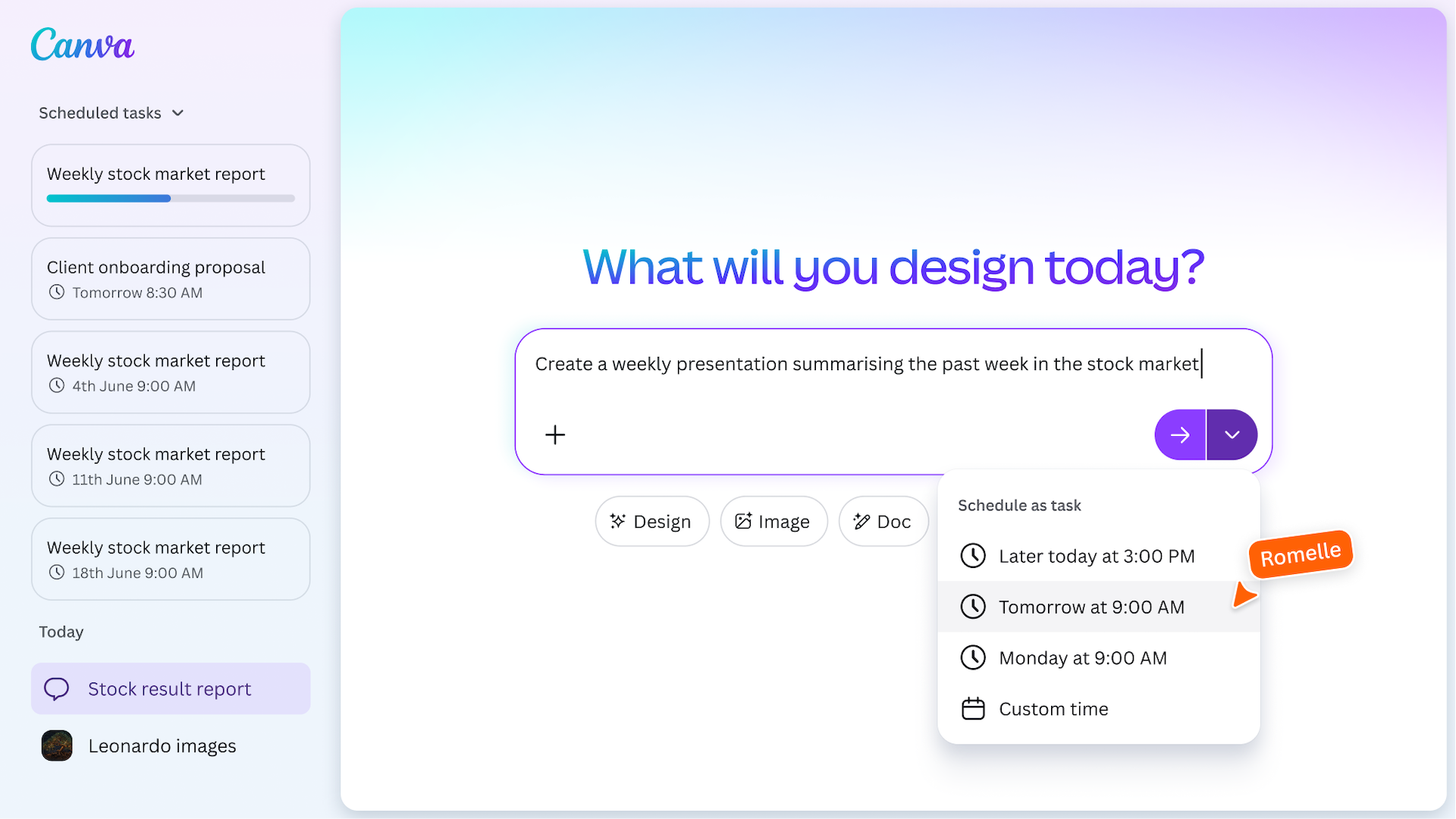
  • Canva AI 2.0 enables autonomous scheduling and task completion in the background for selected users.
  • Canva positions Scheduling as a step toward fully autonomous work, reducing busywork for workers.
  • The feature relies on MCP connectors to provide rich context from apps like Slack, Gmail, and Google Drive.
  • The initiative is described as the 'absolute early adopter stage' for agentic AI by Canva's leadership.
  • Canva envisions Scheduling to help replace busywork and free time for quick visual edits.
  • The article notes a research preview availability limited to a million users.
  • Canva anticipates MCP connector expansion as a major future development.
  • The article frames Canva AI 2.0 as shifting toward AI-assisted design rather than pure automation.
  • Canva’s Scheduling aims to run recurring AI tasks like weekly content and daily briefings.
  • TechRadar identifies Canva’s Scheduling as part of a broader enterprise AI automation trend.
Vote 0
0
#4
DeepL, known for text translation, now wants to translate your voice | TechCrunch
#4 out of 4

DeepL, known for text translation, now wants to translate your voice | TechCrunch

  • DeepL launches a voice-to-voice translation suite for real-time conversations across meetings, mobile, and group settings.
  • An API release will let developers build on DeepL’s tech for customized translation use cases such as call centers.
  • CEO Jarek Kutylowski says voice translation is a natural next step after years in text translation.
  • DeepL plans add-ons for Zoom and Teams to offer real-time translation audio or translated text on screen.
  • A QR-based group conversation feature will let participants join via a code for remote collaboration.
  • DeepL aims to build an end-to-end voice translation model that bypasses the text step entirely.
  • Competitors include Sanas, Camb.AI, and Palabra, each advancing voice or translation tech.
  • DeepL highlights potential for translation in customer service in languages with scarce staff.
  • The article positions this as a significant expansion beyond DeepL’s text translation roots.
Vote 0
0

Explore Your Interests

Unlimited Access
Personalized Feed
Full Experience
or
By continuing, you agree to the Privacy Policy.. You also agree to receive our newsletters, you can opt-out any time.

Explore Your Interests

Create an account and enjoy content that interests you with your personalized feed

Unlimited Access
Personalized Feed
Full Experience
or
By continuing, you agree to the Privacy Policy.. You also agree to receive our newsletters, you can opt-out any time.

Advertisement

Advertisement