Your Followed Topics

Top 2 jupiter, solar system News Today

#1
NASA’s Juno Reveals New Insights into Cosmic Ray Origins - NASA Science
#1 out of 2
science14h ago

NASA’s Juno Reveals New Insights into Cosmic Ray Origins - NASA Science

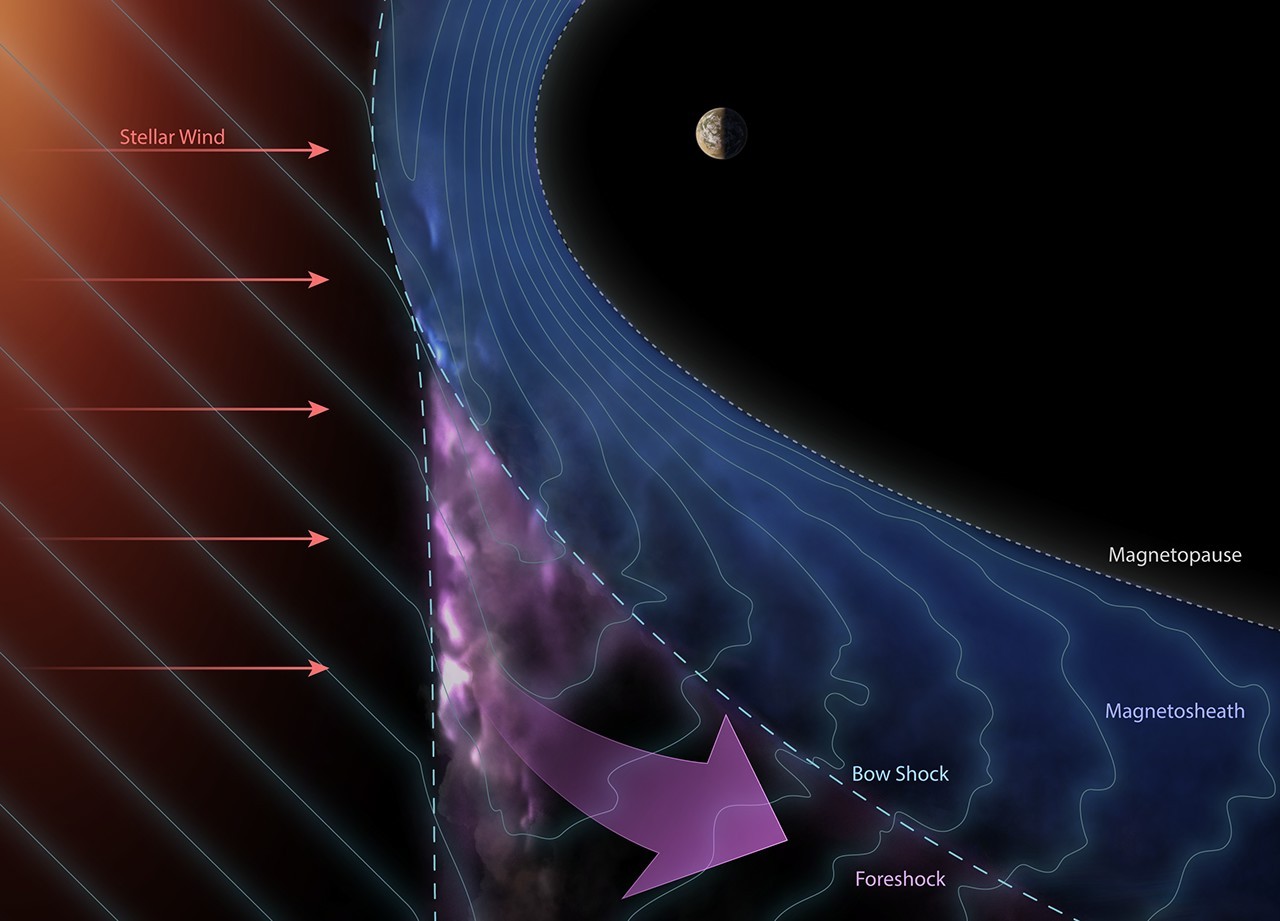
  • NASA’s Juno confirms high-energy electrons accelerate in Jupiter’s foreshock, near the bow shock.
  • The speeds scale with Jupiter’s larger bow shock, linking particle energy to planetary size.
  • The study demonstrates a scaling relationship between electron speeds and Jupiter’s magnetic environment.
  • Scientists connect Jupiter’s acceleration process to cosmic rays observed from supernovas across the galaxy.
  • Juno’s findings build on prior missions MMS and THEMIS and extend to larger planetary systems.
  • Nature published the research detailing Jupiter’s foreshock acceleration mechanism.
  • The work links solar energetic particles to broader cosmic ray processes in the universe.
  • The research suggests a universal mechanism for particle energization in magnetic environments.
  • The article emphasizes the foreshock as a key region where acceleration begins.
  • Juno’s measurements around Jupiter were crucial to confirming the acceleration mechanism.
Vote 0
0
#2
Relativistic electron acceleration at the bow shock of Jupiter and beyond - Nature
#2 out of 2
science8h ago

Relativistic electron acceleration at the bow shock of Jupiter and beyond - Nature

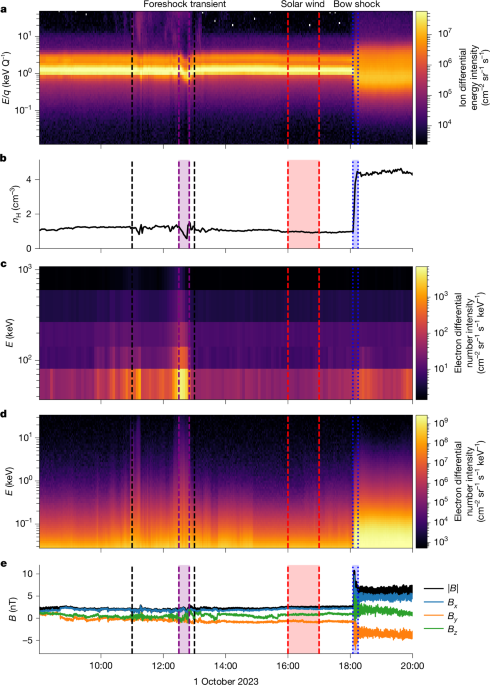
  • Latest finding: Juno observed relativistic electrons upstream of Jupiter's bow shock within a large foreshock transient.
  • Scale matters: the transient spans several Jupiter radii and dictates the acceleration region size L.
  • Spectral evidence matches diffusion shock acceleration expectations with a power-law tail.
  • The study links planetary foreshocks to a universal scaling law for maximum energy.
  • Hillas-like constraint applied to derive Emax from L and B fields.
  • Planetary data validate the model at Earth, Saturn, and Jupiter scales.
  • Astrophysical applicability remains tentative but physically plausible.
  • SN 1006 and SN 1987A are used to test the model's astrophysical predictions.
  • The work emphasizes the foreshock transient as an efficient accelerator beyond the shock front.
  • Future work includes applying the framework to additional astrophysical shocks.
Vote 0
0

Explore Your Interests

Unlimited Access
Personalized Feed
Full Experience
or
By continuing, you agree to the Privacy Policy.. You also agree to receive our newsletters, you can opt-out any time.

Explore Your Interests

Create an account and enjoy content that interests you with your personalized feed

Unlimited Access
Personalized Feed
Full Experience
or
By continuing, you agree to the Privacy Policy.. You also agree to receive our newsletters, you can opt-out any time.

Advertisement

Advertisement