#1
#1 out of 1
14h ago
Discovery of stromatolite formation in post-impact hydrothermal lacustrine environments and its implications for early Earth - Communications Earth & Environment
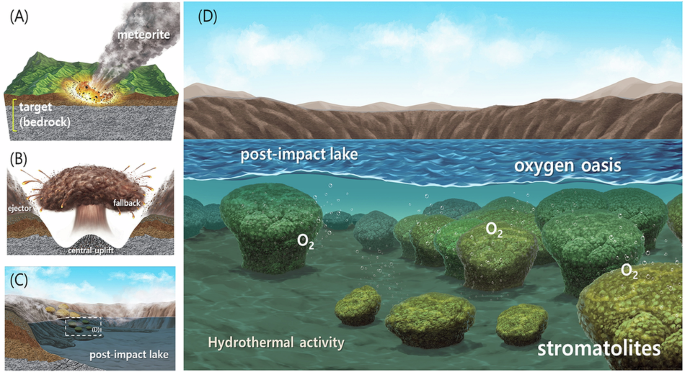
- Newly discovered Hapcheon crater stromatolites formed in the early post-impact lake under hydrothermal influence.
- Researchers used radiocarbon dating and microanalyses to map growth periods from about 7,000 to 30,000 years ago.
- Europium anomalies in stromatolites point to hydrothermal fluid interactions during growth.
- Osmium isotope data suggest a meteoritic component in the stromatolites and surrounding sediments.
- The crater’s early lake had high calcite and Ca flux, indicating in situ precipitation and hydrothermal activity.
- DNA evidence suggests thermophilic and geothermal-associated microbes in deep lake sediments.
- The study links meteoritic input and hydrothermal activity to crater-lake stromatolite formation.
- The Hapcheon crater shows a multi-stage history from impact to post-impact lake development.
- Stromatolites at Hapcheon show age-reversal radiocarbon patterns due to old carbon inputs.
- The research integrates multiple methods to trace hydrothermal influence on life-supporting habitats.
- Findings encourage considering crater environments as potential habitats for early life and Mars analogues.
Vote 0