Your Followed Topics

Top 2 gemini observatory News Today

#1
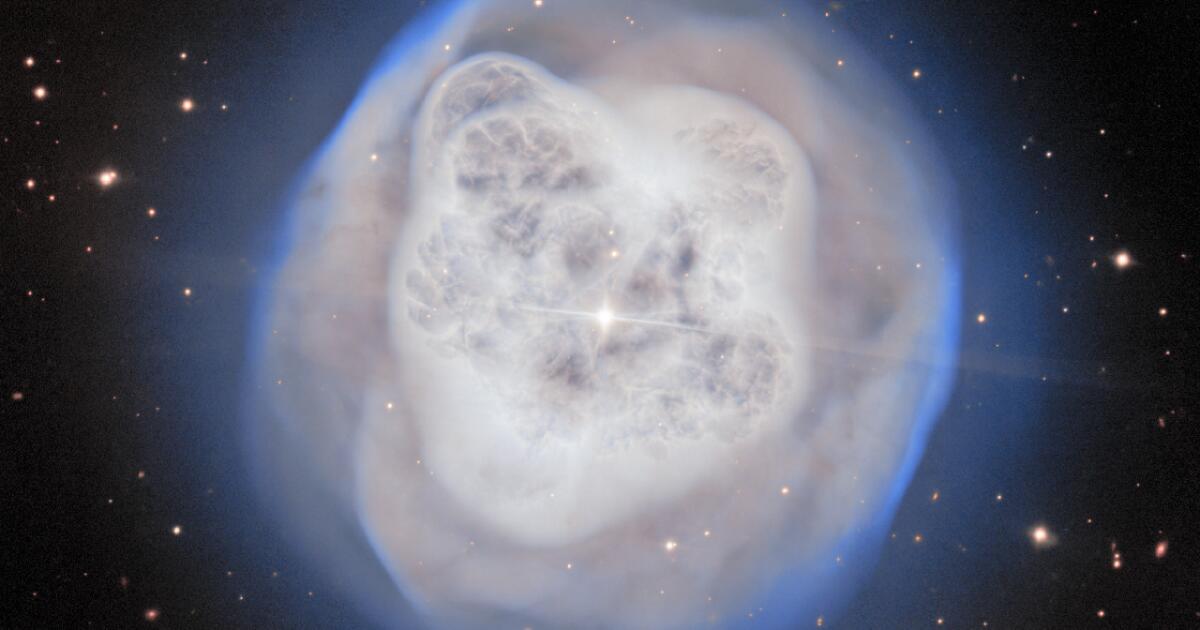
Dying star resembles a billowing crystal ball in new telescope photo
#1 out of 2
1d ago

Dying star resembles a billowing crystal ball in new telescope photo

  • Astronomers captured a dying binary star system in a vivid color image from Gemini North, revealing the Crystal Ball Nebula around NGC 1514.
  • NGC 1514’s glowing cloud forms as the star sheds outer layers late in its life, heating the gas to tens of thousands of degrees.
  • NOIRLab operates Gemini North, which last year observed the nebula before a color processing update last week.
  • The Crystal Ball Nebula is about 1,500 light-years away from Earth.
  • The nebula’s glow results from heating of the gas to tens of thousands of degrees by the exposed core.
  • The report notes the star system once contained stars larger than the sun and is near the end of its life.
  • The NOIRLab operates the Gemini North Telescope that produced the new image.
  • Researchers say the color image was completed recently, providing a fresh view of the nebula.
  • The story is reported by Marcia Dunn of the Associated Press for the Los Angeles Times.
  • The article mentions related science and environment items in the Times' latest sections.
Vote 0
0
#2
Alien winds may reveal hidden truth about exoplanets' magnetic fields
#2 out of 2
13h ago

Alien winds may reveal hidden truth about exoplanets' magnetic fields

https://mashable.com/science/exoplanet-magnetic-fields-measuredhttps://www.space.com/astronomy/exoplanets/hot-jupiter-winds-blasting-at-over-15-000-mph-reveal-1st-evidence-of-exoplanets-with-magnetic-fields
Mashable.com and 1 more
  • New reference provides first direct evidence that exoplanets can have magnetic fields, inferred from unusually fast winds on seven hot Jupiters.
  • Wind speeds on these seven tidally locked exoplanets reach up to about 15,500 mph, with magnetic fields likely moderating the flows.
  • The hotter the planet, the slower its winds, suggesting global magnetic braking shapes atmospheric dynamics.
  • Magnetic fields of these exoplanets are estimated to be in the same general range as solar-system gas giants, not extremely stronger than Jupiter.
  • These magnetic environments could drive dramatic auroras on exoplanets, rivaling Earth's northern lights.
  • Wind speeds offer a proxy to gauge exoplanet magnetic field strengths, informing how magnetism shields atmospheres from stellar radiation.
  • The discovery marks a major step toward comparing magnetic environments across worlds, aiding the search for habitable conditions.
  • The new results provide context for why some hot exoplanets emit few radio signals, aligning with weaker magnetic fields.
  • The study used premier ground-based observatories (VLT and Gemini North) to measure exoplanet winds with high precision.
  • The seven exoplanets studied are ultra-hot gas giants in very close orbits, exposing them to intense stellar irradiation.
Vote 1
0

Explore Your Interests

Unlimited Access
Personalized Feed
Full Experience
or
By continuing, you agree to the Privacy Policy.. You also agree to receive our newsletters, you can opt-out any time.

Explore Your Interests

Create an account and enjoy content that interests you with your personalized feed

Unlimited Access
Personalized Feed
Full Experience
or
By continuing, you agree to the Privacy Policy.. You also agree to receive our newsletters, you can opt-out any time.

Advertisement

Advertisement